Before money, people exchanged goods with each other. Grain for livestock, tools for food. This worked fine locally where people knew each other, but was inefficent as trade with others expanded. Ancient Mesopotamia (modern-day Iraq). Historians found that Sumerians who were the world's first civilization, around 3000 BCE, recorded transactions on clay tablets, marking one of the erliest forms of money transactions.

tmb-7-1-1.jpg

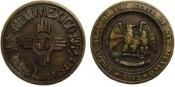
New Mexico officially became the 47th U.S. state on January 6, 1912. This medal was created in 1962 to mark the 50th anniversary of that event. One side of the medal features the Great Seal of the State of New Mexico, which was officially adopted by the territorial legislature in 1887 and retained when New Mexico became a state.

tmb-2-1-1.jpg

This coin was minted in Zacatecas, a region renowned for its rich mining history, particularly its silver lodes discovered in 1548. As the silver equivalent to the larger copper quarter real, it represents the smallest coin minted in Mexico during that era. These 1/4 reales were struck with the federal inscription for various years, including 1852 and 1862, among others.
tmb-1-4-1.jpg

This medal or token was issued by "Calzado GE-CE-SA," a shoe company based in León, Mexico, as indicated by the text "HECHO EN LEON PARA MEXICO" (Made in León for Mexico). While the 1968 Mexico Olympics are known for the official 25 Pesos silver commemorative coin, this item is distinct as it features the shoe company's branding, suggesting it was likely a promotional or souvenir item rather than official currency.

tmb-1-4-2.jpg

These coins were part of the currency issued during Mexico's First Republic period (1824-1864). This particular type was issued by the State of Chihuahua, as indicated by the inscription "ESTADO DE CHIHUAHUA" on the coin. The 1846 variety without the fraction bar is considered a scarce type, making it of interest to collectors. Other years of issue for similar Chihuahua 1/4 Real coins include 1833 and 1834.